
If your café, bubble tea shop or juice bar is under pressure to cut single-use plastic, you have probably looked at compostable cups and asked the obvious questions: Are they actually better for the environment? Will they hold up with a cold drink? And how much more will they cost me per cup?
PLA cups are the most common answer to all three. This guide covers what they are made of, how they behave in real service conditions, how they compare to PET and PP, and how to choose the right size, lid and printing option for your menu — so you can decide with numbers instead of marketing claims.
What Are PLA Cups?
PLA stands for polylactic acid, a plastic made from renewable plant feedstock — most commonly fermented corn starch or sugarcane — rather than from petroleum.
Two things matter for buyers:
- They are plant-based. The raw material is annually renewable, which is why PLA is often described as “bio-based plastic.”
- They are industrially compostable. Under controlled industrial composting conditions (sustained high temperature and humidity), PLA breaks down into water, carbon dioxide and biomass. It does not break down reliably in a home compost heap or in a landfill, and it should not be treated as litter-friendly.
That second point is the one most suppliers gloss over. Selling a PLA cup as “it just disappears” is inaccurate. The honest framing — and the one that keeps you out of trouble with customers and regulators — is: PLA is a plant-based, industrially compostable alternative to petroleum-based plastic, and it performs best when your market has the waste infrastructure to match.
Our own PLA cup range is here: PLA Cups
PLA vs PET vs PP: Which Cup Material Fits Your Menu?
PLA vs PET vs PP: Which Cup Material Fits Your Menu?
| PLA | PET | PP | |
| Raw material | Plant-based (corn / sugarcane) | Petroleum-based | Petroleum-based |
| Appearance | Clear, slight haze compared to PET | Crystal clear | Clear to frosted |
| Best for | Cold drinks, eco-positioned brands | Iced coffee, boba, juice, smoothies | Hot drinks, boba, sealing-film lines |
| Heat resistance | Low — around 40–50°C | Low — cold drinks only | High — hot and cold |
| Compostable | Industrially compostable | no | no |
| Cost per cup | Highest of the three | Moderate | Lowest |
The practical takeaway: if you serve hot drinks, PLA is not the material — use PP. If you serve cold drinks and your brand positioning or local regulation rewards compostable packaging, PLA is the choice. If you serve cold drinks and cost is the driver, PET remains the workhorse.
PLA Cup Sizes: What to Stock
PLA cups follow the same rim-diameter system as PET cups, which is what actually determines lid compatibility.
| Rim diameter | Typical sizes | Common use |
| 78mm | 5.5-9oz | Small juice, espresso-based cold drinks, samples |
| 89mm | 10-24oz | Iced coffee, single-portion smoothies |
| 92mm | 8-16oz | Bubble tea, fruit tea, standard boba menu |
| 98mm | 12-32oz | Large boba, sharing cups, iced tea |
Two rules that save a lot of headaches:
- Size and rim diameter are different things. A 16 oz cup can come in more than one rim diameter. Always order lids by diameter, not by ounce.
- Stock two rim sizes, not six. Most cafés and tea shops run a clean menu on 89 mm and 98 mm, or 90 mm and 98 mm. Fewer rim sizes means fewer lid SKUs, less dead stock and faster service.
Clean PLA cups in 78 mm, 89 mm, 98 mm and 117 mm salad bowls are available in our range: PLA Cups
Lids and Sealing: Getting the Fit Right
A compostable cup with a petroleum-based lid defeats the purpose for customers who notice. Two options:
PLA-compatible lids. Rigid or dome lids made from the same material family, so the whole package is compostable. Dome lids suit topped drinks; flat lids with straw slots suit straight drinks.
Sealing film. For high-volume tea shops, sealing film is faster and more leak-resistant than a lid. It also reduces packaging weight. If you run a sealing machine, confirm with your supplier that the film is compatible with PLA cup rims — film designed for PP rims can fail to bond correctly on PLA.
We supply matching PLA Lids sized to the cups above.
Whichever route you choose, order a sample set and run it through your actual service — a lid that pops loose under a full cup is not something you want to discover on a Friday afternoon.
Custom Printing on PLA Cups
PLA takes print well, and this is usually where the eco decision starts paying back. - Flexographic printing — 1 to 6 colors directly on the cup wall. The standard for volume orders.
- In-mold labeling (IML) — a printed label fused into the cup during molding. Sharper artwork, photographic detail, and it does not peel.
- UV printing — good for short runs and detailed multi-color artwork.
Artwork considerations specific to PLA: because the cup has a slight natural haze rather than PET’s glass-like clarity, solid, high-contrast color blocks read better than fine gradients and thin lines. If your logo depends on subtle tonal detail, ask for a printed sample before committing to a full run — not a digital mockup.
Custom logo printing options: Custom Logo
MOQ and pricing: PLA carries a higher material cost than PET, so quotations are volume-sensitive. Tell us your sizes, annual volume and artwork, and we will quote factory-direct with samples.
Does the Cost Difference Make Sense?
PLA typically costs more per cup than PET. Whether that is worth it depends on what you are buying with the premium:
Where PLA pays off: - Local regulations or venue policies that restrict petroleum-based single-use plastic
- Brand positioning where customers actively look for compostable packaging
- Corporate, event and institutional clients with sustainability procurement criteria
- Markets with industrial composting collection in place
Where it does not: - Hot drink menus (wrong material — use PP)
- Purely price-driven distribution with no end-customer pressure
- Markets with no composting infrastructure, where the cup ends up in landfill anyway and you are paying a premium for a claim you cannot substantiate
The honest position: PLA is a genuine material improvement, but it only delivers full value where the waste system can complete the loop. Sell it as an informed choice, not as a magic fix — that protects your brand from the “greenwashing” backlash that hits suppliers who overclaim.
FAQ
Are PLA cups recyclable?
PLA is technically recyclable in dedicated industrial streams, but in practice it should not go into conventional PET or mixed-plastic recycling — it can contaminate those streams. Route used PLA to industrial composting where available.
Can PLA cups hold hot drinks?
No. PLA softens at low temperatures (roughly 40–50°C). Use PP for hot beverages. There are heat-resistant PLA variants and lined paper cups for hot service, but standard clear PLA cups are cold-drink only.
Do PLA cups biodegrade in landfill?
Not reliably or quickly. Industrial composting requires sustained high temperature and humidity that a landfill does not provide. Do not market PLA as litter-degradable.
Can I use my existing PP lids on PLA cups?
Sometimes the rim dimensions match, but the fit is not guaranteed. Order lids specified for PLA rims, and always test a full cup before a production run.
How do PLA cups compare in clarity to PET?
PLA is clear but has a slight haze; PET is closer to glass-clear. If maximum visual clarity is your priority, PET still wins. If compostability is the priority, PLA’s clarity is more than adequate for most branded drinks.
What is the MOQ for custom-printed PLA cups?
It depends on size and print method. Send us your artwork and volume target and we will confirm MOQ and lead time with samples.
Choosing PLA Cups: A Quick Checklist
- Confirm your drink menu is cold only (otherwise specify PP for hot)
- Decide rim diameter first, then size — and limit yourself to two rim sizes
- Match lids or sealing film to the PLA rim, and test a full cup
- Ask for a printed sample, not just a digital mockup
- Check whether your market has industrial composting — this is what determines real-world value
- Verify the supplier’s material documentation and food-contact compliance for your destination market
Ready to Source PLA Cups with Your Brand?
Tell us your sizes, rim diameter, volume and artwork. Our team replies with factory-direct pricing and samples within 24 hours.
Request a Quote — or message us on WhatsApp.
Internal Links Used
- /pla-cup/ (PLA cups range)
- /pla-lids/ (matching lids)
- /custom-logo/ (custom printing)
- /contact/ (quote form)
Image Suggestions (upload with descriptive filenames + alt text)
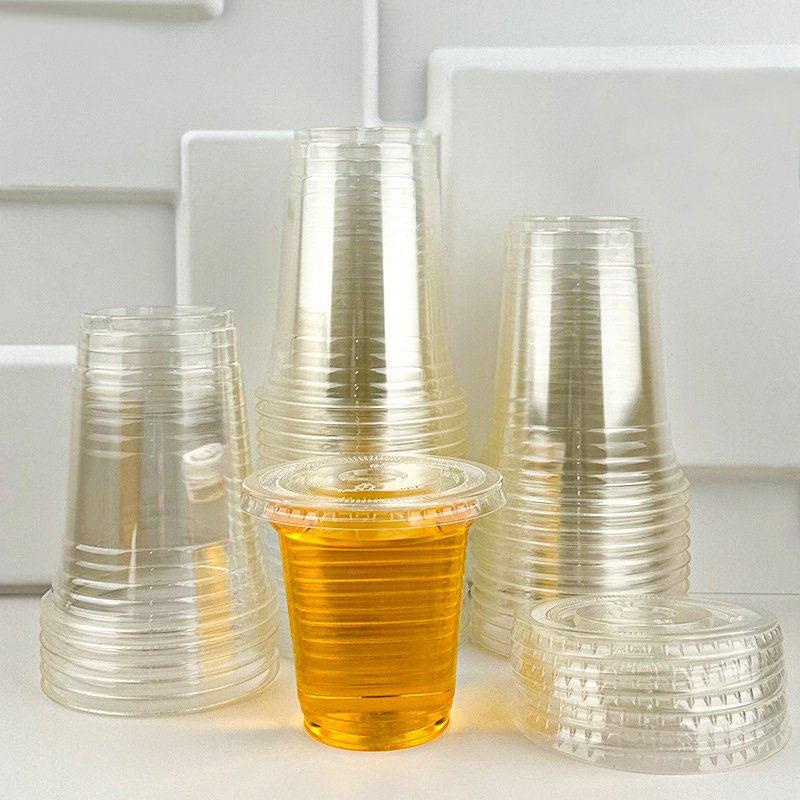
- pla-cups-89mm-clear-cold-drink.jpg — alt: Clear 89mm PLA compostable cups for cold drinks
- pla-vs-pet-cup-clarity-comparison.jpg — alt: PLA cup compared with PET cup clarity side by side
- pla-cup-lids-compatible-fit.jpg — alt: PLA lids fitted on compostable cold drink cups
- custom-printed-pla-cup-logo.jpg — alt: Custom printed PLA cup with brand logo for bubble tea shop
- pla-cup-sizes-78-89-98mm.jpg — alt: PLA cup sizes 78mm 89mm 98mm rim diameters